


WILDSENSING: A Hybrid Framework of Mobile and Sensor Nodes for Wildlife Monitoring
WildSensing is a
cross disciplinary project undertaken by Niki Trigoni’s Sensor Network group, along with Cambridge Computing Laboratory
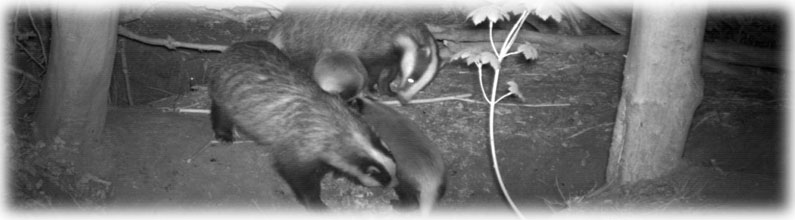
and Oxford’s Wildlife Conservation Research Unit, to monitor wild badgers in their natural habitat in Wytham Woods,
using a mixture of static and mobile sensing technology.
Current approaches using VHF beacons are highly labour intensive and involve night-time tracking. GPS tracking collars typically perform poorly under heavy tree cover. The WildSensing approach was to leverage the power of sensor network technology to provide continuous and long term monitoring. Over 40 animals were equipped with tracking collars which periodically emit radio beacons. In order to rapidly deploy the devices, existing active RFID devices from WaveTrend were used. These transmissions were detected by a network of 30 sensor nodes placed at strategic locations, such as at setts. In a one year operational period, over 26 million transmissions were detected and logged. The deployment experience has led to the development of algorithms to deliver data using a hierarchical delay tolerant approach, surprising results about the effect of rainfall on link behaviour, and hardware and firmware advances. A biologically inspired method of evolving code for distributed networks using an abstraction of Gene Regulation was also devised. The initial data has revealed some interesting badger behaviour which has previously been speculated upon, but never before been observed directly, such as dispersal of animals from one sett to another.
Underground tracking
Another avenue of research that has been recently explored is localizing badgers when they are underground. Radio signals are unable to penetrate soil, and thus conventional tracking modalities cannot be used. Instead, a novel method using low frequency magnetic fields was developed. As a byproduct of localizing animals over time, the tunnel structure itself can be revealed. This new research area is likely to lead to some interesting discoveries about badger social structure underground, something which has been impossible to do until now. Click here to find out more.
News
Our presentation on MI tracking of underground animals won the best presentation award at ACM SenSys 2010!
Selected Publications
-
Underground Localization in 3−D Using Magneto−Inductive Tracking
Andrew Markham‚ Niki Trigoni‚ David Macdonald and Stephen Ellwood
In IEEE Sensors Journal. Vol. 12. Pages 1809−1816. 2012.
Details about Underground Localization in 3−D Using Magneto−Inductive Tracking | BibTeX data for Underground Localization in 3−D Using Magneto−Inductive Tracking | Link to Underground Localization in 3−D Using Magneto−Inductive Tracking
-
WILDSENSING: Design and Deployment of a Sustainable Sensor Network for Wildlife Monitoring
V. Dyo‚ S. Ellwood‚ D. Macdonald‚ A. Markham‚ N. Trigoni‚ R. Wohlers‚ C. Mascolo‚ B. Pasztor‚ S. Scellato and K. Yousef
In ACM Transactions on Sensor Networks. 2012.
Details about WILDSENSING: Design and Deployment of a Sustainable Sensor Network for Wildlife Monitoring | BibTeX data for WILDSENSING: Design and Deployment of a Sustainable Sensor Network for Wildlife Monitoring | Download (pdf) of WILDSENSING: Design and Deployment of a Sustainable Sensor Network for Wildlife Monitoring
-
Effect of rainfall on link quality in an outdoor forest deployment
Andrew Markham‚ Niki Trigoni and Stephen A. Ellwood
In Proceedings of the International Conference on Wireless Information Networks and Systems‚ Athens‚ Greece. July, 2010.
Details about Effect of rainfall on link quality in an outdoor forest deployment | BibTeX data for Effect of rainfall on link quality in an outdoor forest deployment | Download (pdf) of Effect of rainfall on link quality in an outdoor forest deployment
Sponsors
Principal Investigator
People
Share this:


